


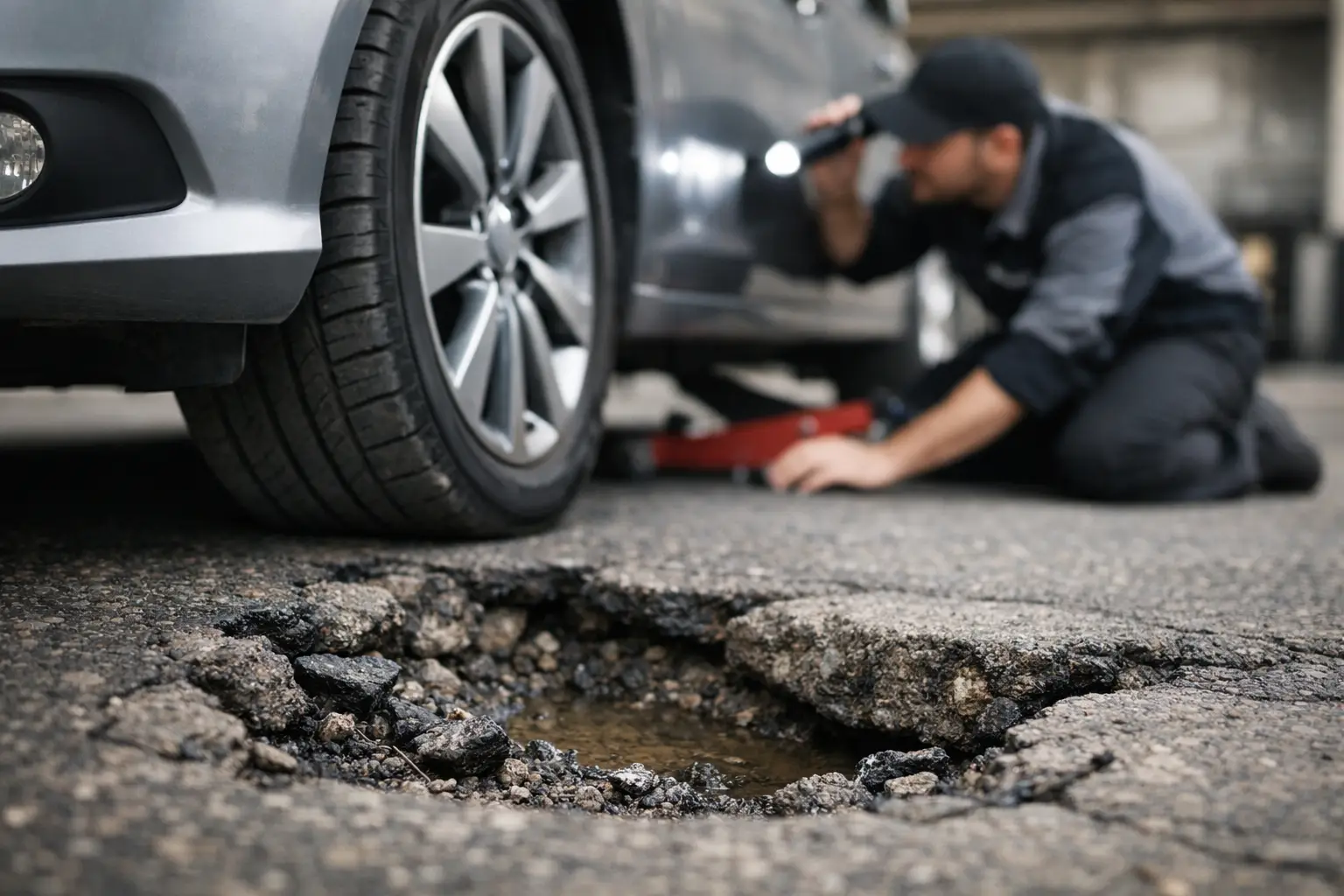
You know the moment. One hard hit, a sharp thump through the cabin, and after that the car just doesn’t sound right. If you’ve noticed suspension noise after pothole impact, it’s not something to brush off and hope disappears by next week. A pothole can do more than upset the ride – it can knock suspension, steering or wheel components out of line, and the noise is often the first warning.
Sometimes the sound is minor and the fix is straightforward. Other times, that clunk, knock or squeak points to damage that affects handling, tyre wear and braking stability. The key is working out whether the car is safe to keep driving and how quickly it needs attention.
Why suspension noise after pothole damage happens
A pothole hit loads the suspension very suddenly. Instead of dealing with a normal bump, the wheel can drop sharply into the hole and then slam into the edge as it climbs back out. That force travels through the tyre, rim, shock absorber, strut, springs, control arms, bushes, ball joints and steering parts.
Modern suspension systems are built to cope with rough roads, but they still have limits. If a part was already worn, a pothole may be the final push that turns wear into a clear fault. That’s why one driver can hit a pothole and carry on, while another ends up with a clunking front end and a steering wheel that no longer sits straight.
The sound itself matters. A metallic knock can suggest looseness or impact damage. A creak may point to a bush or mount under strain. A humming or roaring noise may be more wheel bearing or tyre related than suspension alone. It depends on what was hit, how hard it was hit, and the condition of the vehicle beforehand.
The most common noises and what they can mean
A clunk over bumps is one of the most common complaints after pothole damage. This often happens when there is play in a suspension joint or mount. Worn or damaged sway bar links, control arm bushes, strut top mounts and ball joints are regular culprits.
A knocking sound from one corner of the car can mean the issue is localised to that wheel area. If the noise appears only when turning, steering components such as tie rod ends may be involved. If it happens even on small road imperfections, the suspension may have developed enough looseness that it’s moving where it shouldn’t.
A squeak or creak can be less dramatic, but it still deserves attention. Rubber bushes can tear or shift after impact. Strut mounts can also complain when they’ve taken a hit. In dry conditions, some squeaks are simply aged rubber making itself known, but when the sound starts immediately after a pothole, the timing is hard to ignore.
Then there’s the sharp bang followed by vibration. That can point beyond suspension to a bent rim, damaged tyre sidewall or balance issue. In some cases, the noise you hear as “suspension” is actually the wheel and tyre assembly no longer running true.
What a pothole can damage besides the suspension
This is where it helps not to guess too narrowly. A pothole doesn’t only target one system. It can affect the wheel alignment, tyre, rim, steering rack ends, wheel bearing, lower control arm, shock absorber or even the subframe in severe cases.
Alignment is a big one. If the steering wheel is now off-centre, the car pulls to one side, or the tyres begin wearing unevenly, the impact may have shifted suspension geometry. Sometimes an alignment correction solves it. Sometimes the alignment won’t hold because a bent or worn part needs replacing first.
Tyres also deserve a close look. A bulge in the sidewall means internal tyre damage, and that tyre should not be trusted at speed. A cracked rim or flat spot can create noise, vibration and safety risk. So even if the suspension itself is fine, the car may still be unsafe.
When it’s safe to drive and when it’s not
If the noise is mild, the car drives normally, and there’s no pulling, vibration or warning lights, you may be able to drive it carefully for a short period until it’s inspected. But that’s not the same as ignoring it.
If the noise is loud, constant, or paired with poor steering response, uneven ride height, strong vibration, or visible tyre or wheel damage, it’s better not to keep driving unless necessary. A loose suspension or steering component can get worse quickly, especially on rough local roads, speed humps and roundabouts.
Braking behaviour matters too. If the car feels unstable under brakes after a pothole strike, stop treating it as a noise issue only. At that point, you may be dealing with a safety problem.
Quick checks you can do before booking a mechanic
You don’t need to crawl under the car on the nature strip to get useful clues. Start with a simple walk-around. Look for a tyre that appears low, a sidewall bulge, fresh scuffing on the rim, or one corner of the car sitting lower than the others.
Then think about when the noise happens. Is it only over bumps, only while turning, or at steady speed as well? Does it come from the front or rear? Did it begin immediately after one pothole hit, or build up over the next few drives? These details help narrow down the likely fault and speed up diagnosis.
It’s also worth checking whether the steering wheel is centred on a straight road and whether the car tracks evenly. If it drifts left or right without reason, mention that when you book the inspection.
How a mechanic diagnoses suspension noise after pothole impact
A proper inspection usually starts with a road test, because the exact conditions that trigger the sound matter. After that, the vehicle is checked for free play, damaged bushes, leaking shocks, bent components, tyre damage and wheel issues.
The important part is not just finding a noisy part, but finding the part that was affected by the impact. Sometimes the first noise leads to a second issue. For example, a pothole may damage a control arm bush, which then throws out alignment and accelerates tyre wear. Fixing only the tyre won’t solve the whole problem.
This is also why cheap guesswork can become expensive. Replacing parts based on noise alone without checking the rest of the corner assembly can leave the actual fault untouched.
Why delaying repairs can cost more
A small amount of play in a bush or joint may not feel urgent today, but suspension faults rarely improve on their own. They usually create extra movement, and extra movement wears out nearby parts faster.
Misalignment can chew through tyres. A failing strut mount can place more stress on the strut. A loose steering end can affect handling and tyre stability. What starts as an occasional knock after one pothole can end up as a bigger repair job a month later.
For busy drivers, the bigger cost is often disruption. It’s not just the repair bill – it’s taking time off work, rearranging school runs, or dealing with a car that suddenly feels unreliable.
The practical next step
If your car has developed a new noise after hitting a pothole, trust the change. Cars usually tell you when something’s off, and new sounds rarely appear for no reason. The sooner it’s checked, the more likely the fix stays simple.
For drivers in Wallan and Melbourne’s northern suburbs, mobile inspections can make this much easier. Instead of trying to juggle workshop drop-offs, a mechanic can assess the vehicle at home or work, check for suspension, steering, wheel and tyre issues, and help you decide whether it’s safe to drive or needs repair straight away. That practical, no-fuss approach is why many locals turn to Hazara Mobile Mechanic when a car starts making a noise that wasn’t there yesterday.
If the car feels different after a pothole, don’t wait for the noise to get louder before acting on it.
Need a mobile mechanic?
Hazara Mobile Mechanic comes to you across Wallan and up to 70 km around. Open 7 days, 7am to 10pm, with emergency service 24/7. Call or text 0466 666 945, message us on WhatsApp or book online. See our services and the areas we cover.

Comments are closed