


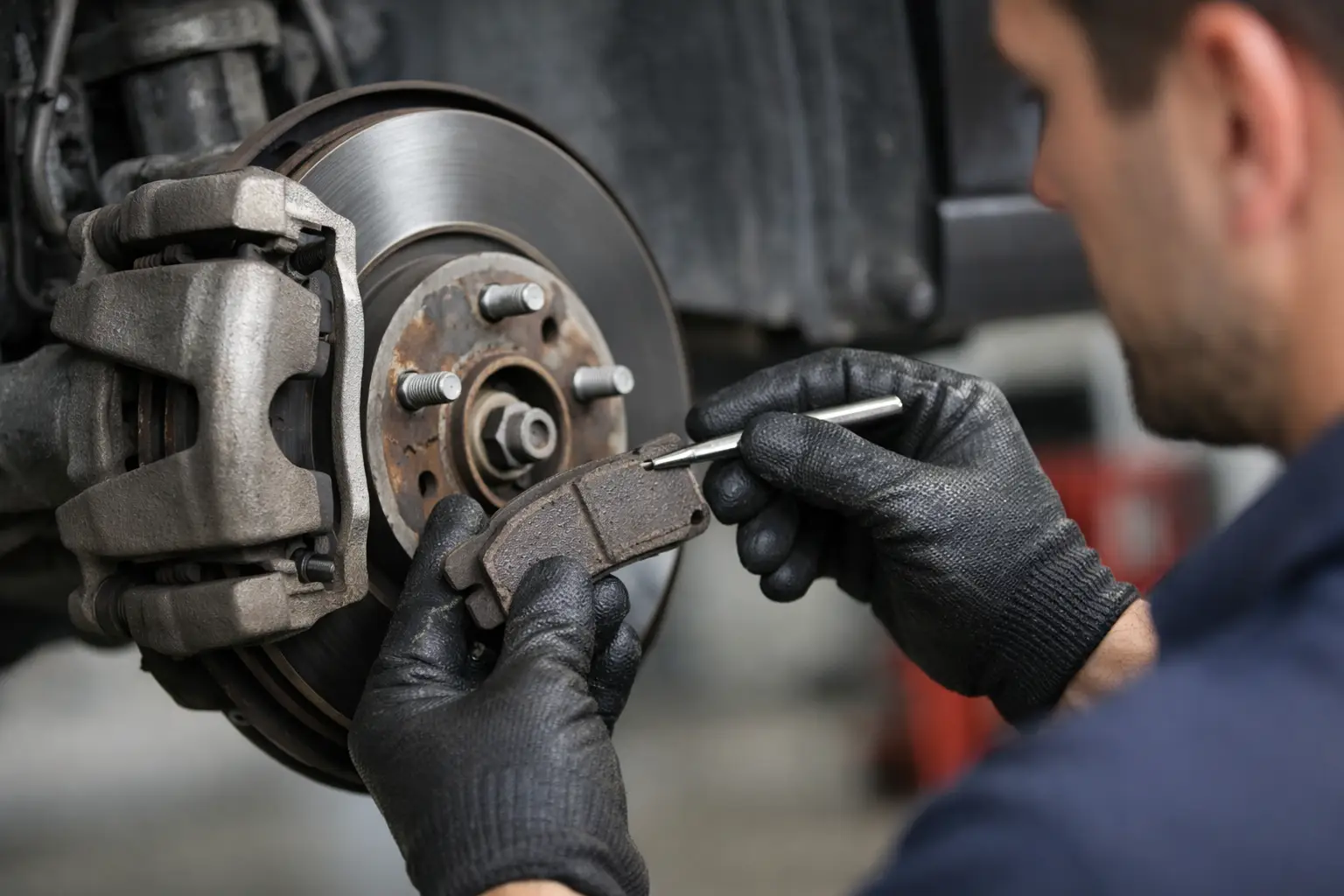
A squeal at the lights, a grinding sound in traffic, or a brake pedal that suddenly feels different – that is usually when most people start thinking about their brake pads. The better time is before any of that starts. If you want to know how to check brake pads, the good news is you can often get a clear idea of their condition without doing anything complicated.
Brake pads are designed to wear down slowly, so small checks now and then can help you catch problems early. That can save you from damage to the brake discs, longer stopping distances, and a repair bill that grows because the warning signs were ignored.
How to check brake pads without guessing
The most reliable way to check brake pads is to look at the pad material itself. On many cars, you can see the outer brake pad through the wheel spokes with a torch. You are looking for the friction material pressed against the brake disc. If there is only a very thin layer left, or it looks uneven, it is time to take it seriously.
As a general guide, anything around 3 mm or less is getting close to replacement time. New pads are much thicker than that, so if what you can see looks paper-thin, do not leave it for another few weeks and hope for the best. It is also worth remembering that the inner pad can wear faster than the outer one, so a quick visual check is useful, but it is not always the full story.
If your wheels make it hard to see the brakes clearly, the wheel may need to come off for a proper inspection. That gives you a much better view of the pad thickness, the disc surface, and whether the wear is even across both sides.
Signs your brake pads may be worn
You do not always need to see the pads to suspect a problem. Cars usually give a few clues. A high-pitched squeal is one of the most common. Many brake pads have a wear indicator that makes noise when the pad material gets low. That sound is there for a reason, so it should not be ignored.
Grinding is more serious. If the pads have worn down too far, metal can contact metal. At that point, stopping performance can drop and the disc can be damaged. A brake job that could have been straightforward may then turn into replacing pads and discs together.
You might also notice the car taking longer to stop, a brake pedal that feels less responsive, or a slight pull when braking. Those symptoms do not always mean the pads alone are the issue. It could also point to uneven wear, a sticking caliper, or another brake fault. That is why brake checks are best treated as a safety check, not just a quick look for one part.
A simple at-home brake pad check
If you are checking your own vehicle at home, start on level ground and make sure the car is secure. Switch the engine off, apply the handbrake if appropriate, and let the brakes cool if you have been driving. Brake components get very hot, and checking them straight after a trip is not worth the risk.
Turn the steering wheel slightly if that helps you see the front brakes more clearly through the wheel. Use a torch rather than relying on daylight alone. The brake disc is the smooth metal rotor, and the pad sits against it. You want to identify the friction material, not the metal backing plate.
If you can see a healthy amount of pad material, that is reassuring, but still listen to the car and pay attention to how it brakes. If visibility is poor, or you are not confident identifying what you are looking at, do not guess. A rushed inspection can lead to false confidence, which is worse than simply asking for a proper check.
When a wheel-off inspection makes more sense
Some vehicles make visual checks easy. Others do not. Tight wheel designs, dust build-up, and brake layouts can make it difficult to tell how much pad material is left. In those cases, removing the wheel gives a more accurate answer.
A wheel-off inspection also helps uncover issues you cannot spot through the spokes. Uneven pad wear is a good example. If one pad is wearing much faster than the other, the problem may not be the pad itself. It may be a seized slider, a sticking caliper piston, or poor movement in the hardware. Replacing the pads without sorting that out usually means the new set will wear badly too.
For everyday drivers, this is where professional help often saves time. A proper brake inspection is quick for an experienced mechanic and gives you a clearer picture of what is safe now and what might need attention soon.
How often should you check brake pads?
It depends on how and where you drive. If you spend a lot of time in stop-start suburban traffic, your brake pads may wear faster than someone doing mostly highway kilometres. Hills, towing, carrying heavy loads, and driving habits all play a part as well.
As a practical rule, it is worth checking your brake pads every service or every few months if you do a lot of driving. If you hear noise, notice reduced braking performance, or feel vibration through the pedal, check them sooner. There is no benefit in waiting for a warning light or obvious brake failure.
Many drivers assume brake pads wear evenly and predictably, but real-world driving is not that neat. One side can wear faster. Front pads usually wear faster than rears, but not always. That is why timing matters less than paying attention.
What to look for beyond pad thickness
Pad thickness matters most, but it is not the only thing worth checking. The disc surface should look relatively smooth. Deep grooves, heavy scoring, or blue heat marks can point to wear or overheating. If the pad material looks cracked, crumbling, or glazed, that is also a concern.
Brake dust on its own is not unusual, but very heavy dust on one wheel compared with the others can suggest uneven brake operation. If the car pulls to one side when braking, that can mean one side is not working as it should.
It is also worth noticing smells. A sharp burning smell after normal driving may suggest a brake is dragging. That is not something to put off, especially if the wheel feels unusually hot.
Common mistakes when checking brake pads
One of the biggest mistakes is assuming the outer pad tells the whole story. On some cars, the inner pad wears faster and stays hidden unless the wheel is removed. Another common mistake is confusing the backing plate with the friction material and thinking there is more pad left than there really is.
People also sometimes judge brakes by noise alone. Not all worn pads squeal, and not all squeals mean the pads are completely worn out. Dust, moisture, and pad material can all affect brake noise. Sound is a clue, not a diagnosis.
The other trap is putting off action because the car still stops. Brakes can keep working even when the pads are well past their best. The issue is that performance, safety, and repair costs usually get worse gradually, not all at once.
When to book a mechanic
If you can clearly see the pads are low, if the brakes are noisy, or if the car does not feel right under braking, it is time to have them checked properly. The same applies if you are unsure what you are looking at. Brakes are not the place for a maybe.
For busy drivers, families, and commuters, convenience matters as much as safety. A mobile mechanic can inspect your brakes at home or work, explain what is happening in plain language, and let you know whether you need pads only or a broader brake repair. Hazara Mobile Mechanic helps local drivers in Wallan and Melbourne’s northern suburbs get that sorted without the hassle of losing half a day at a workshop.
Knowing how to check brake pads is useful, but knowing when to stop guessing is just as important. If something feels off, trust that instinct and get it looked at before a small brake issue becomes a much bigger one.
Need a mobile mechanic?
Hazara Mobile Mechanic comes to you across Wallan and up to 70 km around. Open 7 days, 7am to 10pm, with emergency service 24/7. Call or text 0466 666 945, message us on WhatsApp or book online. See our services and the areas we cover.

Comments are closed