


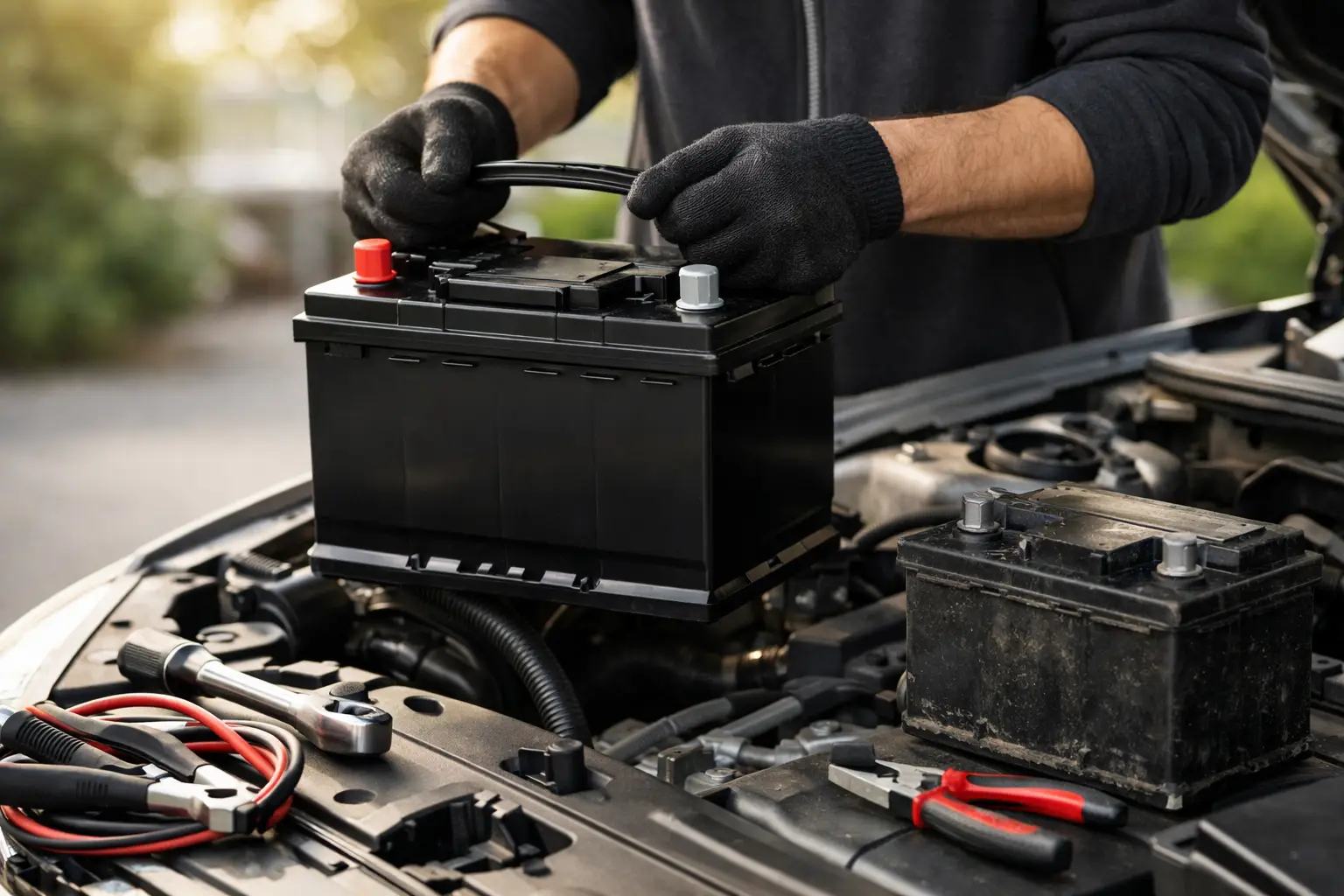
Nothing tests your patience like turning the key before work and hearing a slow crank – or nothing at all. This car battery replacement guide is written for everyday drivers who want a clear answer on what to look for, what to do next, and when it makes more sense to have the battery replaced on site.
A flat or failing battery can feel sudden, but there are usually signs before it gives up completely. The trick is knowing whether you are dealing with a battery at the end of its life, a charging problem, or a simple issue like dirty terminals. If you get that part right, you save time, avoid replacing the wrong part, and reduce the chance of being stranded at home, at work, or in a car park.
When a battery is due for replacement
Most car batteries last around three to five years in normal conditions, but there is no fixed rule. Short trips, stop-start driving, extreme temperatures, long periods without use, and added electrical accessories can all shorten battery life. If your vehicle is mostly used for school runs, local errands, or occasional weekend drives, the battery may wear out sooner than expected.
A few warning signs usually show up first. The engine may crank more slowly in the morning. Headlights can look weaker when the engine is off. You might notice electrical accessories behaving oddly, such as power windows moving sluggishly or the dash flickering on startup. Some vehicles will also show a battery warning light, although that light can point to the charging system as well, not just the battery itself.
Corrosion around the terminals is another clue. A build-up of white, blue, or green residue can interfere with the connection and make the battery appear weaker than it is. Sometimes a clean and secure connection solves the problem. Other times, corrosion is just the visible sign of an ageing battery that is already on the way out.
Car battery replacement guide: check before you replace
Before replacing the battery, it helps to confirm the fault properly. That matters because a dead battery and a flat battery are not always the same thing. A healthy battery can go flat if the alternator is not charging, if a light was left on, or if there is a parasitic drain somewhere in the vehicle.
Start with the basics. Check whether the terminals are tight and free from heavy corrosion. Make sure there are no obvious signs of case swelling, cracking, or leaks. If the battery is old and the car has been struggling to start for days or weeks, replacement is often the sensible next step. If the battery is relatively new and has suddenly gone flat, further testing is worth doing.
Voltage testing can give a useful clue, but it is not the full picture. A battery may show acceptable voltage and still fail under load. That is why proper battery testing is more reliable than guessing from symptoms alone. In some cases, the battery is fine and the real issue is the alternator, starter motor, or an electrical drain. Replacing the battery without checking those possibilities can cost you money and leave the original problem unsolved.
Choosing the right replacement battery
Not every battery suits every vehicle. Size, terminal layout, cold cranking amps, reserve capacity, and battery type all matter. Modern vehicles with stop-start systems often need EFB or AGM batteries rather than a standard lead-acid battery. Fitting the wrong battery can lead to poor performance, warning lights, or shortened battery life.
The simplest option is to match the battery specifications recommended for your vehicle. If your car has extra electrical loads such as dash cams, sound systems, or regular short-trip use, there may be a case for choosing a battery with stronger performance within the manufacturer’s recommended range. Bigger is not always better, though. It still needs to fit the battery tray correctly and suit the vehicle’s charging system.
Price also varies more than many drivers expect. A small hatchback battery will usually cost less than one for a larger diesel, 4WD, or a vehicle with stop-start technology. The cheapest battery on the shelf can be tempting, but lifespan, warranty, and correct fitment matter more than saving a small amount upfront.
How to replace a car battery safely
If you are comfortable with basic vehicle maintenance, replacing a battery can be straightforward. Still, there are a few details that matter. Batteries are heavy, they can produce explosive gases, and incorrect fitting can damage vehicle electronics.
First, switch the engine off, remove the key, and make sure all accessories are off. Wear gloves and eye protection if possible. Locate the battery, which may be under the bonnet, in the boot, or under a seat depending on the vehicle.
Disconnect the negative terminal first. This reduces the chance of accidental short circuits. Then disconnect the positive terminal. Remove any battery clamp or retaining bracket and lift the battery out carefully, keeping it upright. If there is corrosion on the terminals or tray, clean it before fitting the new battery.
Place the new battery in the tray and secure it properly. Connect the positive terminal first, then the negative. Make sure both are tight, but do not overtighten them. Once fitted, start the vehicle and check that everything operates normally.
Some cars may lose radio settings, clock settings, or require window and steering angle resets after power is disconnected. On newer vehicles, battery registration or system reset procedures may also be needed. That is one of the main reasons many drivers prefer professional replacement rather than doing it themselves.
When DIY is fine and when it is better to call a mechanic
There is nothing wrong with doing a battery swap yourself if the battery is easy to access, the fault is clearly battery-related, and your vehicle does not have extra programming requirements. For older cars with simple layouts, it can be a quick job.
It becomes less straightforward when the battery is buried under covers, located in an awkward position, or tied into more complex electronics. The same goes for European vehicles, stop-start systems, and cars that have had repeated battery failures. In those cases, proper testing and fitting matter more than speed alone.
This is where a mobile mechanic service can save a lot of hassle. Instead of arranging a tow or trying to jump-start the car and drive to a workshop, you can have the battery tested and replaced at home or work. That convenience matters when your schedule is tight, when the vehicle will not start, or when you simply want the job done properly without losing half a day.
Common mistakes in any car battery replacement guide
A lot of battery problems come back to small mistakes. One is replacing the battery without checking the charging system. Another is choosing a battery based only on price or physical size. Some drivers also leave a battery unsecured, which can cause vibration damage and shorten its life.
Jump-starting a car repeatedly without finding the underlying issue is another common one. If the battery has failed internally, repeated jump-starts are just delaying the inevitable. If the alternator is faulty, a new battery may go flat again quickly.
There is also the disposal issue. Old batteries should never go in general rubbish. They need to be recycled properly because they contain lead and acid. A mechanic or battery supplier will usually handle this for you as part of the replacement.
What battery replacement usually costs
Battery replacement cost depends on the vehicle, battery type, and whether testing and fitting are included. For many standard passenger vehicles, the difference between a budget battery and a better-quality option is often worth thinking about in terms of reliability rather than just upfront price.
There is also value in proper diagnosis. Paying slightly more for testing and correct fitment can save you from buying a battery you did not need. For drivers in Wallan and Melbourne’s northern suburbs, that matters even more when the car is your daily transport and downtime causes real disruption.
If you are unsure whether the battery is the actual problem, get it checked before committing. A good mechanic will tell you if the battery is done, if the alternator needs attention, or if there is another fault draining power.
A battery is a small part with a big job. When it starts letting you down, the smartest move is not always the fastest guess – it is getting the right answer, then fixing it with as little interruption to your day as possible.
Need a mobile mechanic?
Hazara Mobile Mechanic comes to you across Wallan and up to 70 km around. Open 7 days, 7am to 10pm, with emergency service 24/7. Call or text 0466 666 945, message us on WhatsApp or book online. See our services and the areas we cover.

Comments are closed