


A car that starts slowly in your driveway before work usually gives you a warning before it gives up completely. If you want to know how to test car battery condition before you end up stranded, a few simple checks can tell you a lot without needing a full workshop visit.
Most battery problems show up first as small annoyances. The engine cranks a bit slower on cold mornings, the headlights seem duller than usual, or the dash lights flicker when you turn the key. Those signs do not always mean the battery is dead, but they do mean it is worth checking properly.
Why battery testing matters
Your battery does more than just start the engine. It supports the electrical system, helps stabilise voltage, and works harder than many drivers realise, especially if you do lots of short trips, school runs, or stop-start commuting around Melbourne’s northern suburbs. A battery can test weak even if the car still starts today.
That is why testing matters. It helps you separate a flat battery from a failing one, and it can also point to a different problem such as poor terminals, a charging issue, or a parasitic drain. Replacing a battery too early costs money. Leaving it too late costs time and convenience.
How to test car battery safely
Before you touch anything under the bonnet, make sure the car is parked safely, the ignition is off, and the area is well ventilated. Wear gloves and eye protection if you have them, because batteries contain acid and can produce explosive gases.
Start with a visual inspection. Look at the battery case for swelling, cracks, leaks, or heavy corrosion around the terminals. If the casing is bulging, the battery may have overheated and should not be ignored. If you see white, blue, or green build-up on the terminals, that corrosion can interfere with the connection and affect starting.
Check that the terminal clamps are tight. A loose terminal can act like a bad battery, even when the battery itself is still serviceable. Also have a look at the battery age if there is a sticker or stamped date. Many car batteries last around three to five years in normal use, but heat, driving habits, and charging problems can shorten that.
Testing with a multimeter
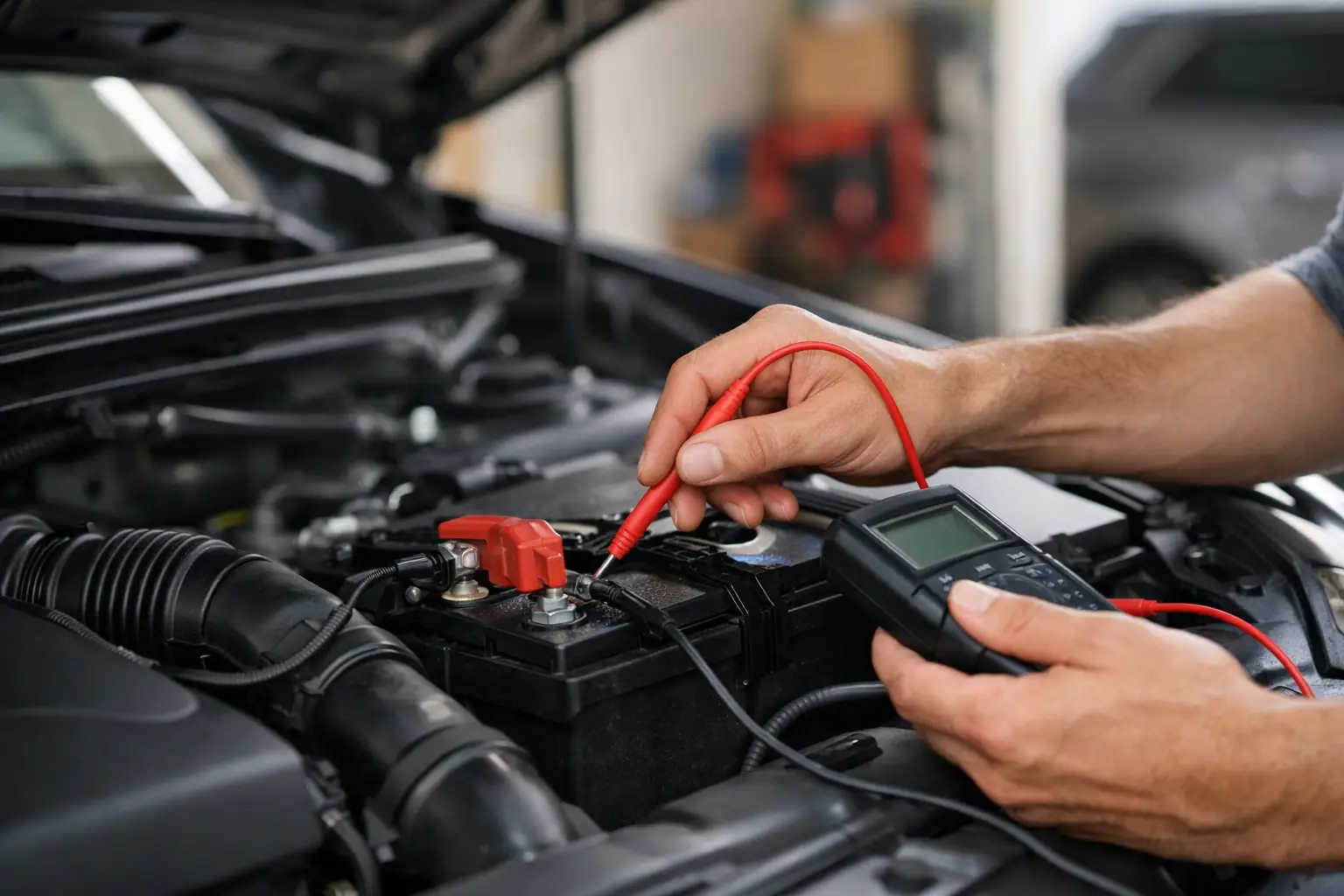
If you want the clearest answer at home, a digital multimeter is the best tool. It is quick, affordable, and useful for more than one check around the car.
Set the multimeter to DC volts, usually on the 20V range. Connect the red probe to the positive terminal and the black probe to the negative terminal. With the engine off and the car sitting for a few hours if possible, you are measuring resting voltage.
A healthy, fully charged 12V battery will usually read around 12.6 volts. A reading of 12.4 volts suggests it is partly charged. Around 12.2 volts means it is significantly discharged, and if it is down near 12.0 volts or below, the battery is very low and may not crank reliably.
Voltage on its own does not tell the whole story, though. A battery can show decent voltage and still fail under load. That is where a cranking test helps.
How to test car battery while cranking
Leave the multimeter connected and have someone start the car while you watch the reading. During cranking, the voltage will drop briefly. In most cases, it should stay above 9.6 volts. If it drops well below that, the battery may be weak, even if the car just manages to start.
This test is useful because it shows how the battery performs under real demand. A battery with internal wear can appear acceptable at rest but struggle when the starter motor draws heavy current.
If the car does not start at all, you can still watch what happens to the voltage when the key is turned. A dramatic drop often points to a battery issue, but if the reading stays fairly steady and nothing happens, the problem may be elsewhere, such as the starter, wiring, or ignition system.
Checking the charging system too
Sometimes the battery is not the real problem. It may simply not be getting charged properly.
With the engine running, test the voltage again across the terminals. Most vehicles should show roughly 13.7 to 14.7 volts while idling. That tells you the alternator is charging the battery. If the reading stays close to the resting battery voltage, the charging system may not be doing its job. If it climbs too high, that can also be a fault and may damage the battery over time.
This is where DIY testing has limits. You can identify that something is wrong, but not always which part is causing it. A faulty alternator, poor earth, worn belt, or wiring issue can all affect charging.
What if you do not have a multimeter?
You can still do a basic check, but it will be less accurate. Turn the headlights on with the engine off and see whether they look strong and steady. If they are noticeably dim, and the car cranks slowly or clicks when you try to start it, the battery may be low.
That said, this method is only a rough guide. Modern vehicles have complex electrical systems, and guessing can waste time. If you rely on your car every day, proper voltage and load testing is the safer option.
Signs the battery may need replacement
A battery does not always fail overnight. Often, it gets weaker in stages. If you have needed jump-starts more than once, if the engine cranks slowly even after a good drive, or if the battery keeps going flat after charging, replacement may be the practical choice.
Age matters as well. If the battery is four or five years old and now testing marginal, replacing it can save you the hassle of a no-start at the worst possible time. For many drivers, that trade-off is worth it, especially if the car is used for commuting, school drop-offs, or weekend travel.
There are exceptions. If the battery went flat because a light was left on, it may recover after a proper recharge. If corrosion was the main issue, cleaning the terminals and securing the clamps may solve it. The point is to test before assuming.
Common mistakes when testing a battery
One common mistake is testing the battery straight after driving and treating that reading as final. Surface charge can make the voltage appear higher than it really is. Letting the car sit first gives a more accurate result.
Another mistake is replacing the battery without checking the terminals or charging system. That can leave you with the same problem and a new battery that eventually suffers the same fate.
It is also easy to overlook how your driving pattern affects battery health. Short trips do not always give the alternator enough time to fully recharge the battery, especially in colder weather or when accessories like the demister and air conditioning are used often.
When to call a mechanic
If your battery tests low once, charging it and retesting may be reasonable. If it keeps failing, if the terminals are badly corroded, or if voltage readings suggest a charging fault, it is time for a proper diagnosis.
That is especially true if you need the issue solved quickly without the hassle of towing or workshop waiting times. A mobile mechanic can test the battery, inspect the charging system, and replace the battery on site if needed. For busy households and commuters, that convenience often matters just as much as the repair itself.
Hazara Mobile Mechanic helps drivers across Wallan and Melbourne’s northern suburbs with on-site battery checks and repairs, which means you can get answers at home or work instead of rearranging your day around a workshop booking.
A practical way to stay ahead of battery trouble
If you want a simple routine, check your battery when seasons change, before longer trips, or any time the car starts behaving differently. Testing takes only a few minutes, and it gives you a clearer picture than waiting to see whether the engine turns over tomorrow morning.
A battery problem is one of those issues that feels minor until it stops your day. Catch it early, test it properly, and you give yourself the best chance of fixing the problem on your terms rather than on the side of the road.
Need a mobile mechanic?
Hazara Mobile Mechanic comes to you across Wallan and up to 70 km around. Open 7 days, 7am to 10pm, with emergency service 24/7. Call or text 0466 666 945, message us on WhatsApp or book online. See our services and the areas we cover.

Comments are closed