


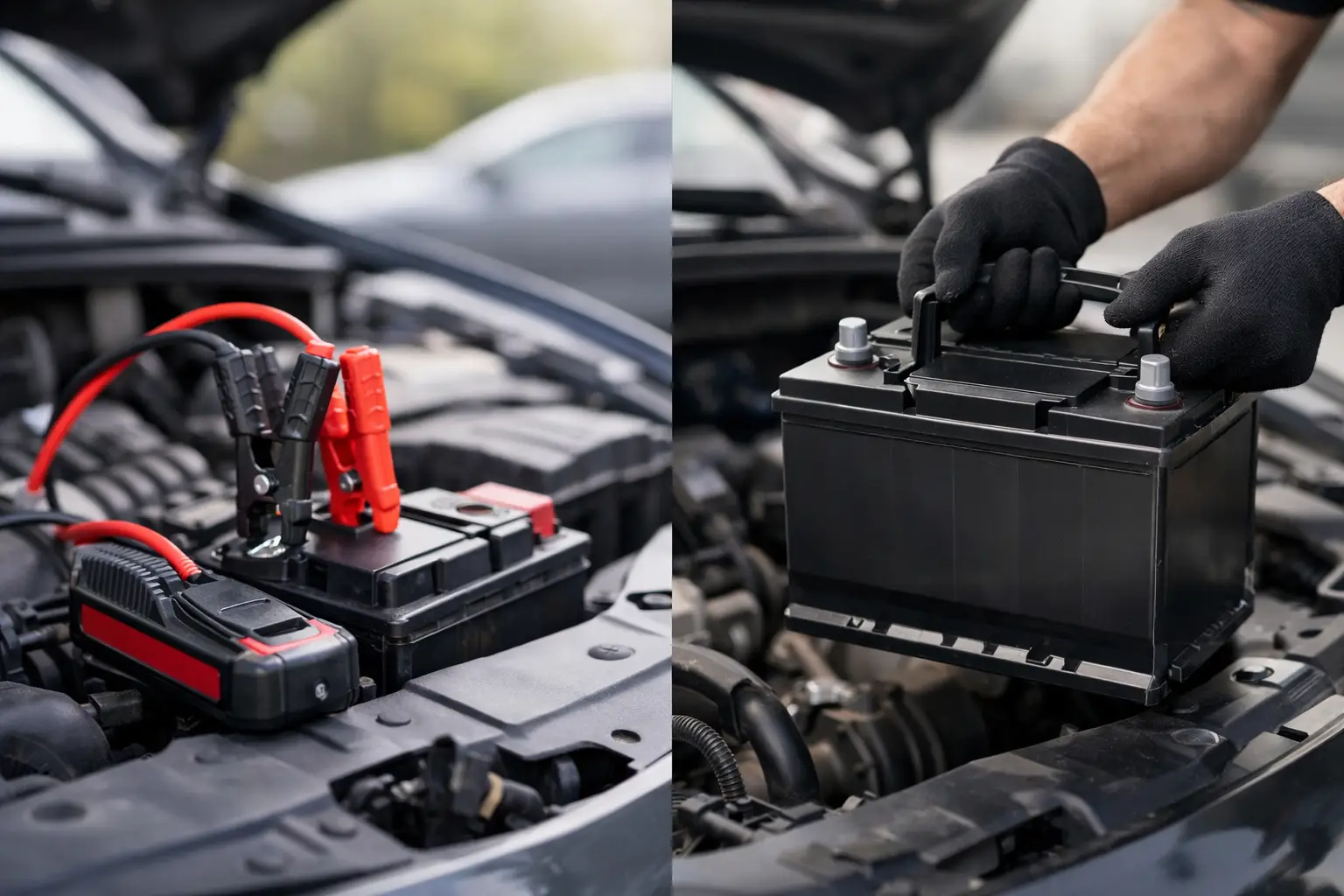
A car that won’t start at home before work or in the office car park after a long day usually brings up the same question – battery jumpstart vs replacement. The tricky part is that both can get you moving, but only one is the right fix for the actual condition of the battery. If you choose wrong, there’s a fair chance you’ll be dealing with the same problem again sooner than you’d like.
Battery jumpstart vs replacement – what’s the difference?
A jumpstart is a short-term solution. It gives your battery enough external power to crank the engine so the alternator can take over and recharge the battery while you drive. If the battery is still in decent condition and has only gone flat because of something like interior lights being left on, a jumpstart may be all you need.
A battery replacement is the proper fix when the battery itself is no longer reliable. That usually means the battery can’t hold charge properly, has reached the end of its service life, or has internal damage that charging won’t solve. In that case, jumpstarting may get the engine running once, but it won’t restore the battery’s health.
This matters because a flat battery and a failed battery are not the same thing. One can often be recovered. The other is already on borrowed time.
When a jumpstart makes sense
A jumpstart is often the right call when the battery has been drained by circumstance rather than age. Maybe the headlights were left on overnight. Maybe the car sat unused for too long. Maybe there was a one-off electrical drain and the battery simply needs to be brought back up.
If the vehicle starts normally after the jumpstart and continues to start reliably over the next few days, the battery may still be serviceable. This is especially true if the battery is relatively new and there are no signs of swelling, leakage or corrosion around the terminals.
Cold mornings can also expose a battery that is only slightly weak. In those cases, a jumpstart might get you through the day, but it’s still worth having the battery tested. A battery that struggles in mild weather may fail completely during a colder week or after another short trip cycle.
There’s also a practical point here. A jumpstart is fast and convenient when you’re stranded and need immediate help. For many drivers, the priority is simply getting the car started so they can get to work, school pick-up, or an appointment. That’s fair enough. The important thing is not to mistake emergency help for a long-term repair.
When replacement is the better option
If your battery is a few years old and has started going flat more than once, replacement is usually the smarter and cheaper decision in the long run. Repeated jumpstarts don’t solve battery deterioration. They just delay the moment it lets you down completely.
Most car batteries give reliable service for several years, but heat, stop-start driving, short trips and general wear all shorten battery life. In Melbourne conditions, a battery can look fine one week and fail the next, especially if it has already been weakened by age.
Replacement is usually the right move if you notice any of the following: the engine cranks slowly, the battery needs frequent charging, electrical systems seem weaker than normal, or the battery case looks bloated or damaged. A strong sulphur smell is another warning sign and should not be ignored.
It also makes sense to replace the battery if testing shows poor cold cranking performance or low reserve capacity. In simple terms, that means the battery no longer has enough strength to start the car consistently or support the vehicle’s electrical load properly.
Signs your battery is flat, not failed
This is where a proper diagnosis helps. A flat battery often has a clear reason behind it. You might know exactly what happened – a door wasn’t shut properly, a light stayed on, or the car sat unused for weeks. If the battery was healthy before that and there are no other symptoms, there’s a decent chance it can be recharged and kept in service.
Another clue is how the car behaves once started. If it runs normally, restarts later the same day, and shows no obvious electrical issues, the battery may simply have been drained. That said, one flat episode can still shorten battery life, particularly if it was deeply discharged.
This is why testing matters more than guessing. Two batteries can show the same symptom – a no-start condition – while having very different causes and outcomes.
Signs your battery is due for replacement
The strongest clue is repeat trouble. If you’ve already had one jumpstart recently and the car goes flat again, the battery should be treated with suspicion. The same goes for slow cranking first thing in the morning, dim lights at idle, or a battery warning that keeps returning.
Battery age matters too. If the unit is already near the end of its expected life, replacing it before it strands you again is usually the sensible option. Many drivers wait until total failure, but by then the inconvenience is often the most expensive part – missed work, delayed school drop-off, or being stuck away from home.
There are also situations where replacement is the safer choice even if the battery can still be jumpstarted. If the battery has visible damage, corroded terminals that have caused repeated issues, or signs of internal failure, fitting a new battery removes doubt and restores reliability.
Why jumpstarting isn’t always enough
People are often told to drive around for 20 minutes after a jumpstart and the battery will be right. Sometimes that works. Sometimes it doesn’t. It depends on why the battery went flat in the first place and whether the charging system is operating properly.
Modern vehicles also complicate things. Many cars have higher electrical demand than older models, and some need the correct battery type and rating to perform properly. If the battery is weak, a short drive may not restore enough charge. If the battery is failing internally, no amount of driving will fix it.
There’s another issue – the battery may not be the only fault. A charging system problem, parasitic drain, poor terminal connection or starter motor issue can all mimic battery trouble. That’s why replacing a battery without testing can be just as frustrating as repeatedly jumpstarting one that is already finished.
The cost question – cheaper now or cheaper overall?
A jumpstart is usually the lower upfront cost, which makes it attractive when you need fast help. But if the battery is already near failure, paying for multiple call-outs can end up costing more than replacing it once and moving on.
Replacement costs more on the day, but it often saves money, time and stress over the next several months. For busy households and commuters, reliability is worth a lot. Not having to wonder whether the car will start on a cold morning is part of the value.
That’s really the heart of battery jumpstart vs replacement. It’s not just about what gets the engine running today. It’s about what gives you confidence the car will start again tomorrow.
What a proper battery assessment should include
A decent battery check goes beyond seeing whether the engine starts. The battery should be tested for voltage and cranking performance, the terminals and connections should be inspected, and the charging system should be checked to make sure the alternator is doing its job.
It’s also worth looking at how you use the car. Frequent short trips can stop a battery from recharging fully. Long periods of sitting idle can drain it. A vehicle used mainly for school runs and local errands may go through batteries differently from one that sees regular freeway driving.
For drivers in Wallan and Melbourne’s northern suburbs, convenience matters as much as the repair itself. If your car won’t start at home or work, having someone come out, test the battery properly and replace it on-site if needed saves a lot of disruption. That practical support is often what turns a stressful morning into a manageable one.
So, should you jumpstart or replace?
If the battery has gone flat because of a one-off drain and testing shows it still has good life left, a jumpstart and recharge may be enough. If the battery is ageing, repeatedly going flat, or failing load tests, replacement is the better call.
The hard part is that you can’t always tell by symptoms alone. A battery can seem recoverable one day and fail the next. That’s why the safest approach is to treat a jumpstart as immediate assistance, not automatic proof the battery is fine.
If your car has started hesitating, gone flat more than once, or left you second-guessing every time you turn the key, don’t wait for a full breakdown to make the decision. A quick check now is usually a lot easier than dealing with a no-start when you’re already running late.
Need a mobile mechanic?
Hazara Mobile Mechanic comes to you across Wallan and up to 70 km around. Open 7 days, 7am to 10pm, with emergency service 24/7. Call or text 0466 666 945, message us on WhatsApp or book online. See our services and the areas we cover.

Comments are closed