


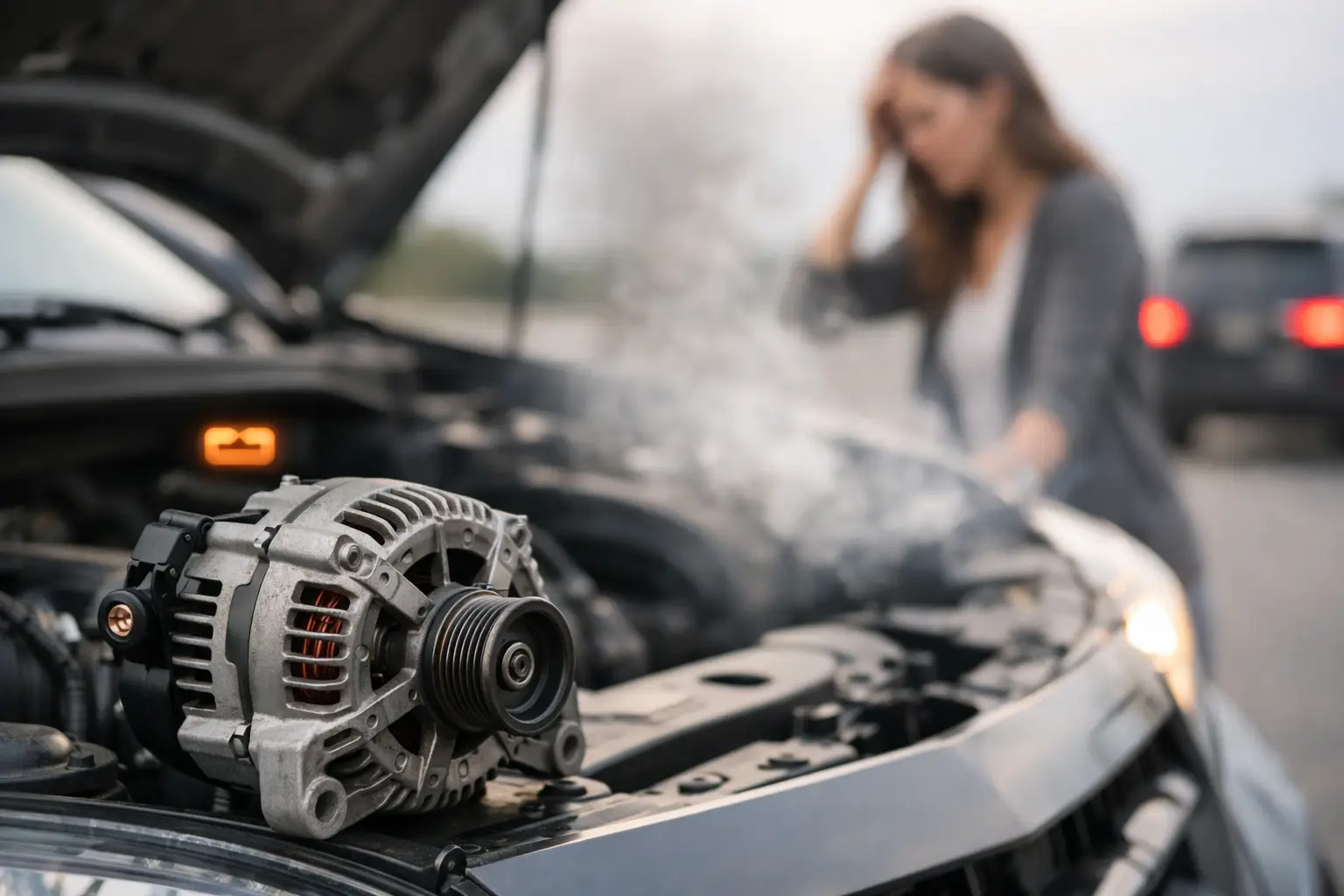
Your car starts fine one day, then struggles the next, and by the time the battery light shows up properly, you are already late for work or stuck in a supermarket car park. That is why knowing the alternator failure warning signs matters. A failing alternator often gives you a bit of notice, but the symptoms can be easy to brush off as a tired battery or a random electrical fault.
For drivers around Wallan and Melbourne’s northern suburbs, this is one of those problems that can shift from annoying to urgent very quickly. The alternator keeps your battery charged and powers the electrical systems while the engine is running. When it starts failing, the car can still drive for a short time, but not for long.
What the alternator actually does
The alternator is part of your vehicle’s charging system. Once the engine is running, it generates electricity to power things like your headlights, dashboard, air conditioning controls, infotainment system and other electronics, while also recharging the battery.
A lot of people assume the battery powers everything all the time, but that is only part of the story. The battery is mainly there to start the car and support electrical demand when needed. After that, the alternator takes over. If it is not doing its job properly, the battery drains and the vehicle eventually stops.
Alternator failure warning signs you should not ignore
Some signs are obvious. Others are subtle and easy to put down to a cold morning, an older battery or a loose connection. The key is looking at the full pattern rather than one symptom on its own.
1. Battery warning light on the dash
This is one of the most common alternator failure warning signs. On many vehicles, the battery-shaped light on the dashboard does not always mean the battery itself is faulty. It can also mean the charging system is not working as it should.
If the light comes on while driving, the alternator may not be charging the battery properly. Sometimes the light flickers at first, especially when using headlights, air con or the demister. That flickering stage is often your early warning.
2. Slow starting or repeated flat batteries
If the car is hard to start, clicks over slowly or needs frequent jump-starts, the battery usually gets the blame first. Fair enough, because batteries do fail. But if a battery keeps going flat after being charged or replaced, the alternator needs attention.
This is where proper diagnosis matters. Replacing the battery may get the car going again for a while, but if the alternator is weak, the same problem will come back.
3. Headlights that dim or brighten unexpectedly
Your headlights should stay fairly consistent while driving. If they dim at idle, pulse, or suddenly brighten when you rev the engine, that can point to unstable voltage output from the alternator.
You may notice this more clearly at night, but it can also show up in the cabin. Dash lights may flicker, interior lights may fade, and the screen on your stereo or infotainment unit might act strangely.
4. Electrical accessories start playing up
Modern vehicles rely heavily on electronics, so charging problems often show up in odd ways. Power windows may move more slowly than usual, the radio may cut in and out, warning lights may appear for no clear reason, or the air conditioning fan may seem weaker.
One isolated electrical issue does not always mean alternator trouble. But when several things start acting up together, especially alongside starting problems or a battery light, the alternator becomes a likely suspect.
5. Strange noises from under the bonnet
A failing alternator can sometimes make a whining or grinding noise. This may happen if the internal bearings are worn or if the pulley is not spinning smoothly.
That said, noises under the bonnet can come from several components, including belts, tensioners and idler pulleys. It depends on the vehicle and the exact sound. A squeal might be a loose belt rather than the alternator itself, but either way, it is not something to leave for later.
6. Burning smell
If you notice a hot, burnt rubber or burnt wire smell, stop and take it seriously. An alternator that is overworking, overheating or suffering internal failure can create heat and smell. A slipping drive belt can do the same.
This is one of those symptoms that deserves quick action, because heat-related faults can damage other parts and increase the risk of a complete breakdown.
7. The engine stalls while driving
This catches many people off guard. Once the alternator stops supplying enough power, the car may continue running only until the battery charge drops too low. Then the engine can stall, often with multiple warning lights appearing at once.
If this happens in traffic, it becomes a safety issue as much as a repair issue. Power steering may feel heavier, and restarting may not be possible.
8. Dead battery after short trips or overnight
A battery that is completely flat after a normal drive or after sitting overnight can point to several issues. It could be battery age, a parasitic drain, poor terminals or an alternator problem.
The important part is not guessing. Charging system faults need testing, because the symptoms overlap. What looks like a battery problem is sometimes an alternator that is only partly charging, which is enough to confuse the situation for days or weeks.
Why alternator problems are often misdiagnosed
Alternator faults and battery faults commonly appear together. A weak alternator can damage a good battery over time, and a failing battery can put extra strain on the charging system. That is why replacing one part without testing the whole system is risky.
There is also the belt to consider. If the alternator belt is worn, loose or contaminated, the alternator may not spin properly even if the unit itself is still usable. In some cases, the repair is simpler and less costly than people expect. In others, the alternator has already failed internally and needs replacement.
What to do if you notice these warning signs
If your car is still running, try to limit unnecessary electrical load. Turn off accessories you do not need, such as seat heaters or extra charging devices, and avoid long trips until the issue is checked. If warning lights are building up or the vehicle is struggling, it is better not to push your luck.
If the car will not start, keeps going flat or shows multiple alternator failure warning signs together, book a proper inspection rather than replacing parts one by one. A mobile mechanic can test battery condition, charging voltage, connections and related components on site, which saves the hassle of organising a tow just to find out what is wrong.
For many drivers, convenience is a big part of the decision. Having someone come to your home or workplace means the issue can be diagnosed where the car sits, whether that is in the driveway, at the office or on the roadside.
Can you keep driving with a bad alternator?
Sometimes, briefly. Often, not for long.
If the alternator is only partially failing, the car may keep going until the battery charge runs down. That could be 30 minutes, a few hours or not much time at all, depending on the vehicle and how much electrical load it is carrying. Night driving, headlights, wipers and air con all make the situation worse.
The problem is you rarely get a clean countdown. The car can go from mostly fine to non-starting very quickly. If you are commuting, picking up the kids or trying to get across town, that is not a great gamble.
A practical way to stay ahead of it
The best time to act is when the symptoms are still mild. A flickering battery light, dim headlights or repeated starting trouble might not feel urgent yet, but they are often the window where diagnosis is easiest and the inconvenience is lowest.
If you are in Wallan or Melbourne’s northern suburbs and your vehicle is showing signs of a charging problem, Hazara Mobile Mechanic can inspect it at your location and help you work out whether the issue is the alternator, the battery, the belt or something else in the system. That saves time, avoids guesswork and gives you a clear next step.
Cars usually give a few hints before the charging system gives up completely. Catch those hints early, and you have a much better chance of fixing the problem before it leaves you stranded.
Need a mobile mechanic?
Hazara Mobile Mechanic comes to you across Wallan and up to 70 km around. Open 7 days, 7am to 10pm, with emergency service 24/7. Call or text 0466 666 945, message us on WhatsApp or book online. See our services and the areas we cover.

Comments are closed