

A clutch rarely fails without giving you a few warnings first. Knowing how to spot clutch failure can save you from being stranded in traffic, stuck in a car park, or facing a more expensive repair after continued driving. If your manual car feels different when changing gears, trust that change and have it checked early.
Your clutch transfers engine power to the gearbox when you move away, change gears or come to a stop. It is a hard-working component, particularly for vehicles used in stop-start Melbourne traffic, on hilly roads or for towing. Wear is normal over time, but a developing problem needs proper diagnosis rather than guesswork.
How to spot clutch failure while driving
The most common early warning sign is clutch slipping. You may notice the engine revs rise quickly when you accelerate, but the vehicle does not pick up speed as it normally would. This is often easiest to notice in a higher gear, when travelling uphill, carrying a load or accelerating onto a freeway.
For example, you press the accelerator and the rev counter climbs, yet the car feels slow to respond. That is different from an engine that is simply underpowered. With clutch slip, the engine is making power but the clutch is no longer holding that power firmly enough to send it through the drivetrain.
Another clear sign is difficulty selecting gears. First gear or reverse may feel stiff, gears may crunch, or you may need to force the gear lever more than usual. Do not keep forcing it. A clutch that is not disengaging fully can make shifting difficult, but similar symptoms can also come from gearbox linkages, transmission oil issues or hydraulic faults. A professional inspection is the sensible next step.
Pay attention to the clutch pedal as well. A pedal that suddenly feels unusually soft, spongy, heavy or sticks near the floor should not be ignored. Some vehicles have a naturally firm pedal, so the key is a noticeable change from how your own car normally feels.
Signs you can notice before the car moves
You do not need to be on the road to notice every clutch issue. A burning smell, often described as similar to burnt paper or overheated brake material, can occur when the clutch is slipping or has been overheated. It may happen after crawling in traffic, reversing up a steep driveway, towing, or repeatedly trying to move off on a hill.
A brief smell after a difficult manoeuvre does not always mean the clutch has failed. However, if the smell returns, the car starts slipping, or gear changes become harder, arrange an inspection soon. Repeated overheating can damage the clutch friction material and may affect related components.
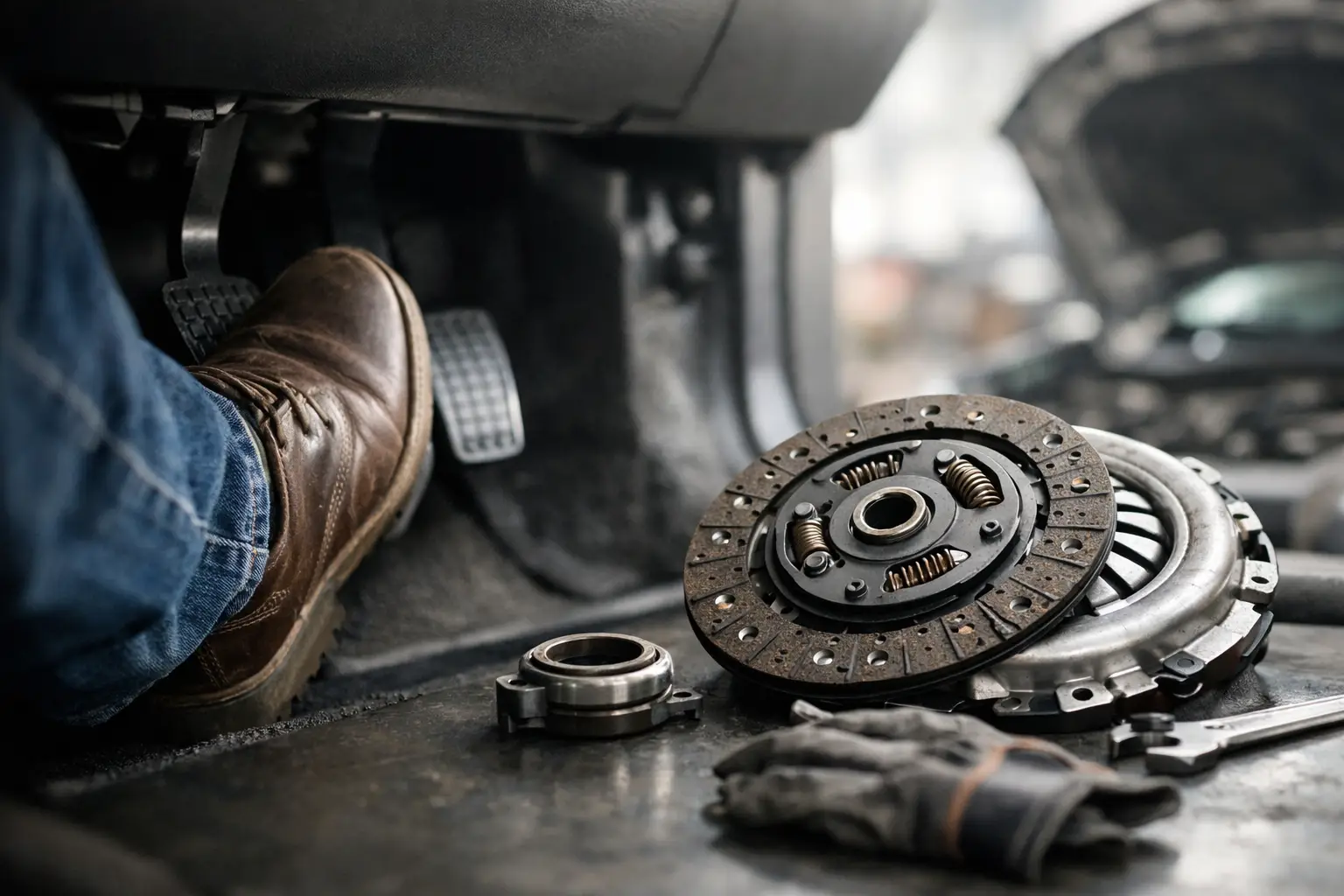
Unusual noises are worth checking too. A whirring, rattling, squealing or grinding sound when you press or release the clutch pedal can point to a worn release bearing, pressure plate issue or another drivetrain fault. The timing of the noise matters. A sound present only with the pedal depressed suggests a different issue from one that occurs while driving in gear.
Look out for these symptoms, especially when more than one appears together:
- Engine revs rise without matching acceleration
- Gears are hard to select, crunch or jump out
- The clutch pedal feels soft, heavy, spongy or slow to return
- A burning smell appears after taking off or driving uphill
- The vehicle shudders, vibrates or judders as you release the pedal
- Noises occur when pressing or releasing the clutch pedal
Clutch failure does not always mean a worn clutch disc
It is easy to assume every clutch problem needs a complete clutch replacement, but the cause can vary. A hydraulic clutch system may have low fluid, a leaking master cylinder or a faulty slave cylinder. In these cases, the pedal may feel soft or sink towards the floor, and the clutch may not disengage properly.
The clutch cable can also be an issue on older vehicles that use a cable-operated system. It may stretch, bind or break, affecting pedal feel and gear selection. Gearbox mounts, engine mounts and drivetrain components can create vibrations that feel like a clutch problem too.
That is why a diagnosis matters before committing to repairs. Replacing parts without identifying the real fault can cost more and leave the original issue unresolved. A qualified mechanic can assess the pedal operation, clutch hydraulics, gearbox behaviour and road symptoms to narrow down what is happening.
What clutch judder feels like
Clutch judder is a vibration or shudder felt through the vehicle as you release the pedal and move away, usually in first gear or reverse. The car may feel as though it is grabbing and releasing instead of moving smoothly.
A little shudder can sometimes be caused by technique, particularly when learning a manual or starting on a steep incline. But a repeated judder with normal driving can indicate wear, contamination on the clutch surfaces, a warped component, worn mounts or an issue with the flywheel.
If your car has a dual-mass flywheel, it may need assessment alongside the clutch. These flywheels are designed to reduce vibration, but they can wear over time. Whether replacement is necessary depends on the vehicle, its condition and the diagnosis, not simply the age or kilometres on the odometer.
Can you keep driving with a failing clutch?
It depends on the symptom, but continuing to drive is usually a gamble. Mild slipping may allow the vehicle to move for a while, yet it often worsens quickly under load. The more a slipping clutch is driven, the more heat it creates and the greater the chance of additional damage.
If the clutch pedal goes to the floor, you cannot select gears safely, there is a strong burning smell, or the vehicle will not accelerate properly, do not try to push through the trip. Pull over somewhere safe when possible and arrange assistance. Trying to force gears or repeatedly rev the engine can turn a manageable repair into a larger job.
For a vehicle that is still drivable but showing early signs, book an inspection promptly. This is particularly important before a long drive, towing a trailer, or relying on the car for daily work or school runs.
Simple habits that help a clutch last longer
Clutches wear, but driving habits affect how quickly that happens. Resting your foot on the clutch pedal, even lightly, can keep pressure on the system and create unnecessary wear. Use the footrest once you have changed gear.
Avoid holding the car on a hill using the clutch. Use the brake or handbrake instead, then move away smoothly. At traffic lights, select neutral rather than sitting in gear with the pedal pressed for long periods. When towing or carrying heavy loads, allow more room to move off and avoid excessive revs.
These habits will not fix an existing clutch fault, but they can reduce stress on a healthy clutch and help you notice when its behaviour changes.
Get the right diagnosis without workshop disruption
Clutch problems are inconvenient because they often show up when you need the car most. A mobile inspection can be a practical option when your vehicle is at home or work and you want clear advice before arranging repairs. Hazara Mobile Mechanic provides straightforward clutch and drivetrain assessments across Wallan and Melbourne’s northern suburbs, with a focus on identifying the fault and explaining the next step clearly.
If your car is slipping, shuddering, making clutch-related noises or refusing to select gears, act while the warning signs are still manageable. A timely check can give you clarity, help protect related components and get you back to dependable driving with less disruption.
Need a mobile mechanic?
Hazara Mobile Mechanic comes to you across Wallan and up to 70 km around. Open 7 days, 7am to 10pm, with emergency service 24/7. Call or text 0466 666 945, message us on WhatsApp or book online. See our services and the areas we cover.

Comments are closed