

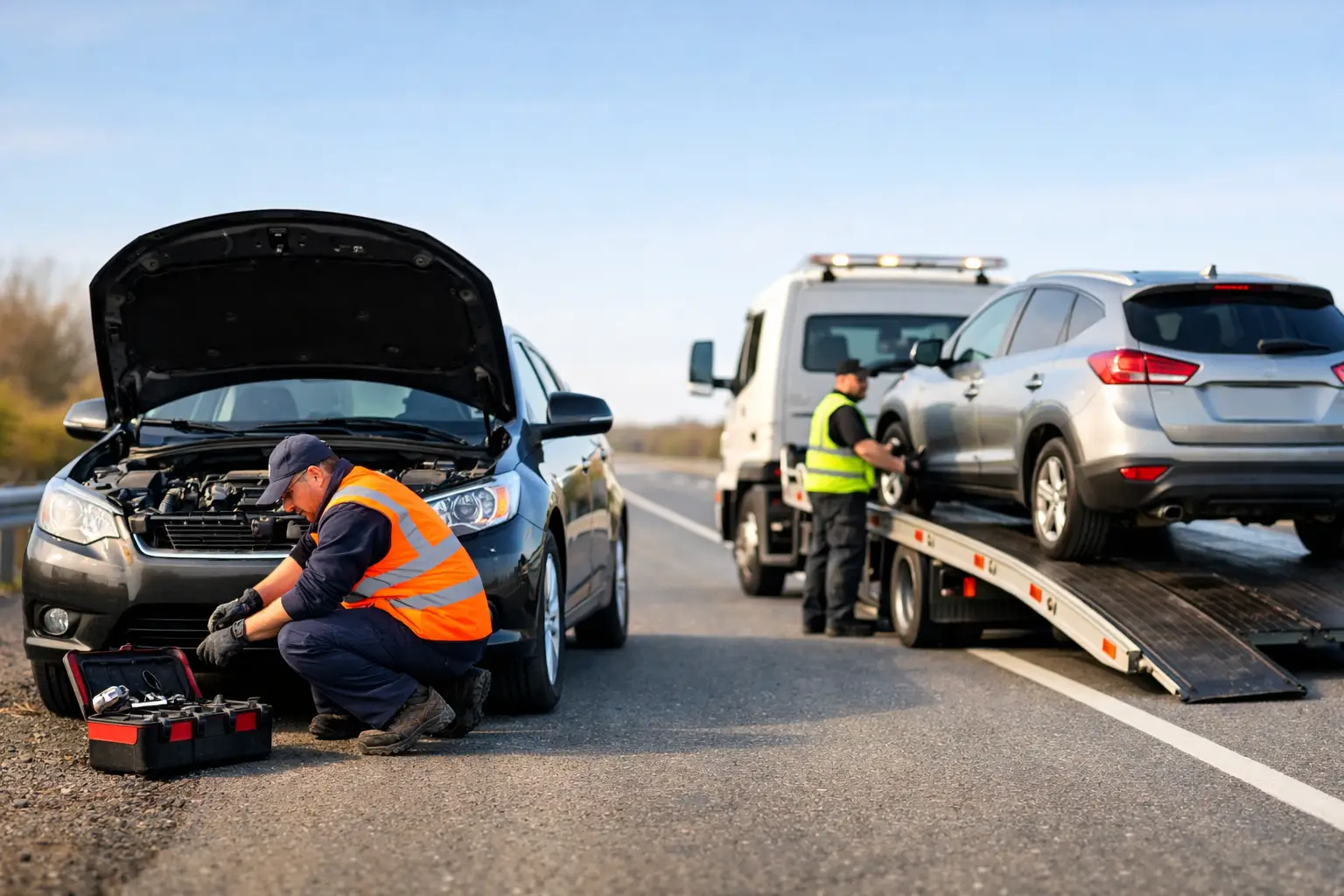
A flat battery outside the Wallan shops, an overheating engine on the way to work, or a car that will not start in your driveway all raise the same question: roadside repair vs towing – which option will get you moving with the least stress and cost? The right answer depends on the fault, where the vehicle has stopped, and whether it is safe to work on or drive.
A tow is sometimes the only sensible option. But many breakdowns can be diagnosed and repaired where your car sits, saving the wait for a tow truck, the trip to a workshop and the disruption to your day. Knowing the difference helps you make a calm decision when the situation feels anything but calm.
Roadside Repair vs Towing: The Main Difference
Roadside repair means a qualified mechanic attends your location with diagnostic equipment, tools and commonly required parts. The aim is to identify the problem and complete a safe repair on site, whether you are at home, at work, in a car park or stranded locally.
Towing moves the vehicle to a workshop, dealership or other approved location so repairs can happen there. It is necessary when the car cannot be safely made roadworthy on site, when specialist workshop equipment is required, or when the breakdown location creates a safety risk.
The choice should never be based on convenience alone. A quick repair is valuable only when it is reliable and safe. Equally, arranging a tow for a straightforward battery or electrical issue can add unnecessary time and expense.
Problems Often Suited to Roadside Repair
Many common faults have a practical on-site solution. A mobile mechanic can test the vehicle, explain what has failed and, where suitable parts are available, carry out the repair without you needing to organise transport or take time off work.
Flat or failing batteries
A battery that has gone flat is one of the clearest examples. The cause may be a worn battery, loose terminals, corrosion or a charging issue. A proper test matters because a jump-start may get the engine running temporarily but will not tell you whether the battery is holding charge or whether the alternator is doing its job.
If the battery is at the end of its life, replacement can often be completed on site. If testing points to a more serious charging fault, the mechanic can advise whether the vehicle can safely be driven or should be towed.
No-start and minor electrical faults
A vehicle that will not start does not always have a major engine problem. It could be a battery, starter motor, ignition issue, blown fuse, faulty sensor or poor electrical connection. On-site diagnostics can narrow down the cause quickly and may allow a repair where the car is parked.
This is particularly helpful when the vehicle is at home before school drop-off or at your workplace at the end of the day. Rather than guessing and replacing parts unnecessarily, the fault can be assessed first.
Cooling and overheating concerns caught early
If the temperature gauge rises but the engine has not suffered damage, a mobile repair may be possible. Low coolant, a leaking hose, a loose clamp or a failed radiator cap can sometimes be addressed on site.
Do not keep driving an overheating vehicle in the hope it will settle down. Pull over safely, switch off the engine and allow it to cool. Never remove the radiator cap while the engine is hot. Continuing to drive can turn a manageable cooling-system repair into significant engine damage.
Tyres, wheels and simple mechanical issues
Some tyre and wheel issues, minor suspension concerns and accessible brake or steering faults can be inspected at your location. The key word is inspected. A mechanic may be able to make a safe repair or confirm that the vehicle should not be driven.
Roadside attendance still has value even when a tow becomes necessary. An accurate diagnosis helps avoid being towed to the wrong place and gives you a clearer understanding of the likely repair before authorising further work.
When Towing Is the Safer Choice
There are situations where the vehicle needs workshop equipment, more time, or a controlled environment. In these cases, towing is not an inconvenience to avoid – it is the responsible next step.
A tow is generally the better option if the engine has seized, there is serious engine noise, smoke is coming from the engine bay, the vehicle has been in a collision, or there is a substantial fuel, coolant or oil leak. You should also avoid driving if the brakes feel unreliable, steering is affected, a wheel is loose or damaged, or warning lights are accompanied by poor vehicle performance.
Transmission and clutch failures may also require towing. If the car will not select gears, slips badly, makes grinding noises or has lost drive completely, forcing it to move can cause more damage. The same applies to major suspension damage, particularly after striking a pothole, kerb or road debris.
Some repairs are simply better done in a workshop. Engine installation, extensive transmission work, major differential repairs and jobs requiring a hoist or specialised machinery cannot always be completed safely at the roadside or in a driveway.
Your Location Can Decide the Outcome
The fault itself is only part of the decision. A car stopped in a secure driveway is very different from one stopped on a busy Melbourne road, narrow shoulder or blind bend.
If you are in an unsafe location, your first priority is getting yourself and passengers away from traffic where possible. Turn on hazard lights, move behind a barrier if it is safe to do so and avoid standing near the vehicle. Do not attempt repairs beside fast-moving traffic, even if the issue appears minor.
A mobile mechanic can carry out many repairs at home, work or in a safe car park. On a dangerous road or where access is restricted, a tow may be needed regardless of how simple the fault appears. Safe working conditions protect you, other road users and the mechanic.
Cost, Time and the Real Value of Each Option
It is understandable to focus on the upfront cost of a call-out or tow. However, the cheapest first step is not always the most economical overall. A tow may involve a call-out fee, distance charges and then workshop labour before the diagnosis even begins. You may also need to arrange a lift home or alternative transport.
Roadside repair can be better value when the problem is straightforward and can be resolved where you are. You avoid the double handling of moving the vehicle first and repairing it later. For busy families and commuters, the time saved can matter just as much as the repair bill.
There are limits. If a repair needs parts that are not immediately available, substantial dismantling or workshop equipment, a mobile mechanic should be upfront about that. A clear recommendation to tow is a sign that safety and quality are being put ahead of a quick sale.
What to Tell the Mechanic or Tow Provider
Accurate information helps the right help reach you sooner. When you call, explain the make and model, your location, what happened before the fault, any warning lights, unusual sounds, leaks or smells, and whether the vehicle is blocking traffic.
It is also useful to say whether the engine starts, whether the car can select gears and whether the steering and brakes feel normal. If the vehicle is automatic, all-wheel drive, electric or hybrid, mention that too. Some vehicles have specific towing requirements, and using the wrong method can cause damage.
Avoid diagnosing the problem yourself based on a warning light alone. A check-engine light, for example, can relate to many different systems. Describing the symptoms clearly is more helpful than assuming the cause.
A Practical Choice for Local Drivers
For drivers in Wallan and Melbourne’s northern suburbs, roadside repair is often the simplest answer to faults that stop daily life without requiring major workshop work. Hazara Mobile Mechanic can assess many issues at your home, workplace or safe roadside location, providing straightforward advice on whether an on-site repair is appropriate or towing is the better path.
If your car is stopped somewhere safe and the problem is not obviously severe, arranging an assessment can prevent unnecessary towing and get you a clear answer quickly. If there is smoke, a major leak, collision damage, unreliable brakes or an unsafe location, treat it as a towing situation from the start. The best outcome is not merely getting the car moving – it is getting it repaired properly and getting you safely back to your day.
Need a mobile mechanic?
Hazara Mobile Mechanic comes to you across Wallan and up to 70 km around. Open 7 days, 7am to 10pm, with emergency service 24/7. Call or text 0466 666 945, message us on WhatsApp or book online. See our services and the areas we cover.

Comments are closed