


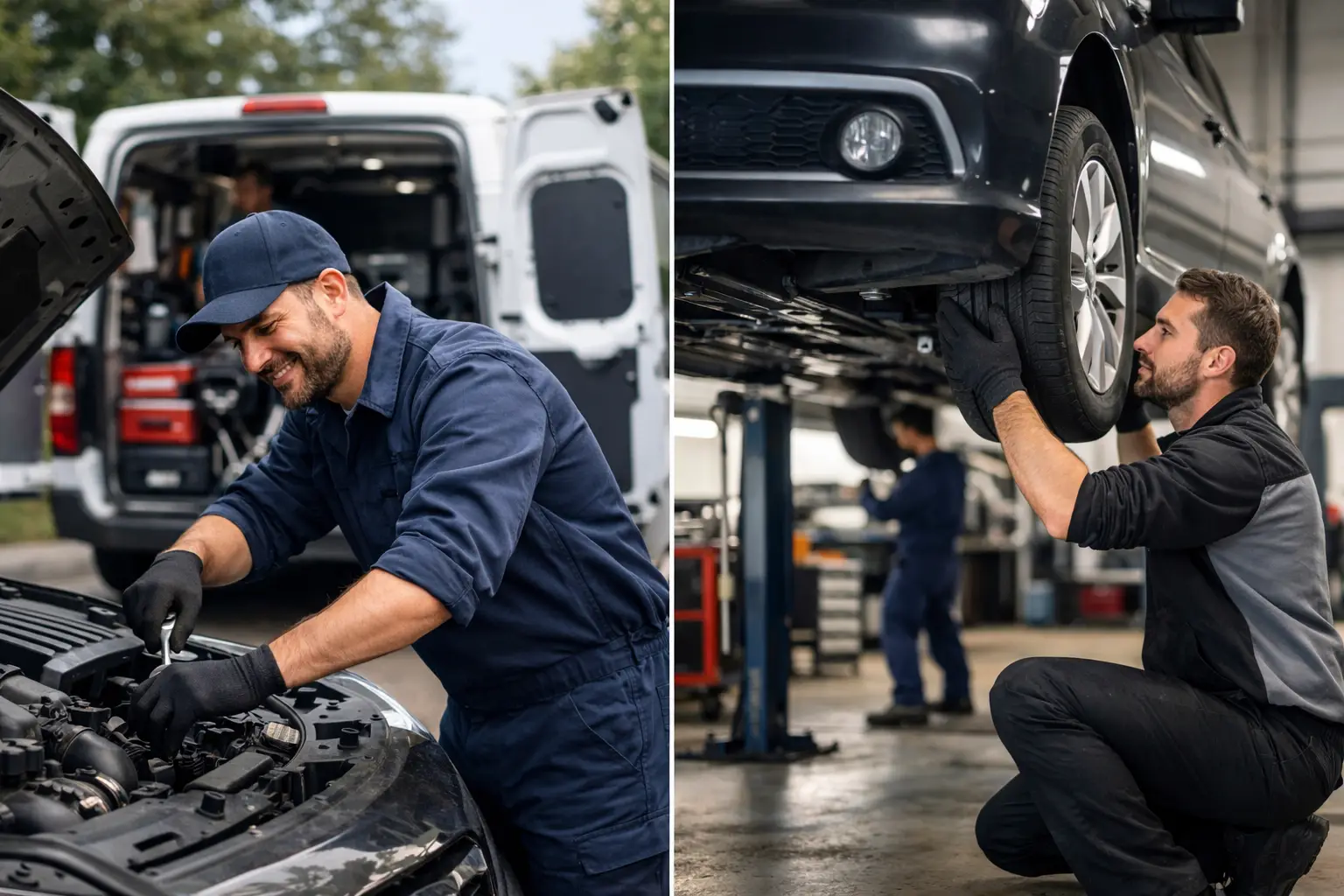
Your car starts playing up on a workday morning. You have school drop-off, a full calendar, and no spare hour to sit in a waiting room. That is usually when the question of mobile mechanic vs workshop stops being theoretical and becomes very practical.
For many drivers in Wallan and Melbourne’s northern suburbs, the right choice comes down to more than price. It is about how quickly the issue can be diagnosed, whether the repair can be done where the car is parked, and how much disruption you are willing to take on. Both options have their place. The better option depends on the vehicle problem, your schedule, and the kind of service experience you want.
Mobile mechanic vs workshop: the real difference
A traditional workshop asks you to bring the vehicle to them. A mobile mechanic brings the tools, diagnostic equipment and experience to your home, workplace or roadside location. That difference sounds simple, but it changes the whole service experience.
With a workshop, you are working around their location and opening hours. With a mobile mechanic, the service is built around where you already are. For busy commuters, families with young kids, and anyone managing a breakdown or flat battery, that can make a big difference.
The other key point is capability. Some people still assume a mobile service only handles basic jobs, but that is outdated. A well-equipped mobile mechanic can carry out a wide range of repairs and servicing on site, including brakes, batteries, suspension work, diagnostics, cooling issues, pre-purchase inspections and more. That said, there are still some jobs where a workshop remains the better fit.
When a mobile mechanic makes more sense
If the car is at your home or work and the repair can be completed safely on site, a mobile mechanic is often the easier option by a long way. You are not arranging a lift, waiting for a tow truck, or losing half a day getting to and from a workshop.
This is especially useful for routine servicing. Logbook servicing, oil and filter changes, brake repairs, battery replacements and many common fault diagnoses can often be done where the car is parked. You keep your day moving while the work gets done.
There is also the breakdown factor. If the vehicle will not start, has an electrical issue, or you suspect a battery or starter problem, getting someone out to you is usually the fastest and least stressful path. In those moments, convenience is not a luxury. It is the difference between a manageable inconvenience and a full day gone.
A mobile mechanic can also feel more transparent. You can speak directly with the person doing the work, see the vehicle where it sits, and ask questions in real time. For many drivers, that builds confidence.
When a workshop is the better choice
Workshops still matter, and for some repairs they are the right call. If the vehicle needs a hoist for extended underbody access, highly specialised machinery, or a repair that will take place over several stages, a workshop may be better equipped.
Major rebuilds, certain transmission jobs, complex fabrication work, and repairs requiring a controlled workshop setup are examples where an in-house facility can be more practical. Not every job is ideal for a driveway or office car park, even with a skilled mobile technician.
There is also the issue of space and safety. If the car is parked in a tight underground bay, on a steep slope, or in a spot that does not allow safe access, the job may need to happen elsewhere. A good mechanic will tell you that upfront rather than force a poor setup.
Cost: is mobile always cheaper?
Not always, but it can be better value.
People often expect a workshop to be cheaper because it has a fixed location and more equipment on hand. In reality, the full cost to you includes more than the invoice. There is fuel, time off work, arranging transport, towing if the car cannot move, and the general disruption of being without your vehicle.
A mobile mechanic may charge a call-out fee depending on the job and location, but that can still work out well when you consider the time saved and the convenience of same-location service. For straightforward servicing and common repairs, mobile can be very competitive.
The better question is not just who has the lowest sticker price. It is who gives you the clearest quote, does the needed work properly, and saves you the most hassle overall.
Time and convenience matter more than most drivers think
This is where the gap between mobile mechanic vs workshop becomes very clear.
A workshop usually means booking ahead, dropping the car off, getting home or to work, then returning later to collect it. If the repair uncovers more issues, timelines can stretch. None of that is unusual, but it does create friction.
A mobile mechanic removes much of that friction. The car stays where it is. You can book around your day. In many cases, there is less waiting around and less interruption to work, family plans or school runs.
For customers who rely on one vehicle, that convenience can be the deciding factor. It is not about avoiding proper maintenance. It is about getting it done in a way that fits real life.
What about quality of work?
This is one of the most common concerns, and it is fair to ask. The setting does not decide the quality of the repair. The mechanic does.
A capable mobile mechanic should be able to diagnose faults accurately, explain the issue clearly, and complete the work to a professional standard using the right parts and tools. A workshop can offer the same, but being in a building does not automatically guarantee better service.
What matters is experience, communication and honesty. If a mobile mechanic can do the job properly on site, you are not sacrificing quality by choosing convenience. If the job is better suited to a workshop, a trustworthy mechanic should tell you that without hesitation.
That honesty is often the clearest sign you are dealing with the right professional.
Choosing based on the type of repair
For everyday servicing and many common repairs, mobile is often the smart option. That includes batteries, brakes, minor to moderate mechanical faults, roadside assistance, cooling issues, inspections and a lot of diagnostic work.
For larger or more specialised repairs, a workshop may still be necessary. The key is not to force every job into one model. It is to choose the option that matches the repair properly.
That is why many local drivers prefer a mechanic who can assess the issue first and tell them whether it can be handled on site or needs a workshop environment. It saves guesswork and helps avoid unnecessary towing or delays.
Which option suits drivers in Melbourne’s northern suburbs?
For local drivers dealing with packed weekdays, school pickups, commuting and limited spare time, mobile servicing often makes strong sense. If your car is parked safely at home or work and the repair can be done there, it is hard to ignore the value of having the mechanic come to you.
That is particularly true for urgent problems. A no-start issue in your driveway, worn brakes discovered before a long trip, or a battery failure at work are all situations where fast on-site support can take a lot of pressure off.
Hazara Mobile Mechanic works with exactly these kinds of everyday situations, helping customers get reliable servicing and repairs without the usual workshop runaround. For many people, that is the difference between putting off a repair and getting it sorted promptly.
How to make the right call
If you are deciding between the two, start with three simple questions. Is the car driveable, can the job be done safely where the vehicle is parked, and does the repair need specialised workshop equipment?
If the answer points to an on-site job, a mobile mechanic is often the more practical choice. If the repair is complex or the location is unsuitable, a workshop may be the better path. There is no one-size-fits-all answer, and any mechanic worth calling will be upfront about that.
The best service is the one that solves the problem properly without making your day harder than it needs to be. If your car can be repaired where it sits, choosing convenience does not mean cutting corners. Often, it just means choosing the option that works better for the way you actually live.
Need a mobile mechanic?
Hazara Mobile Mechanic comes to you across Wallan and up to 70 km around. Open 7 days, 7am to 10pm, with emergency service 24/7. Call or text 0466 666 945, message us on WhatsApp or book online. See our services and the areas we cover.

Comments are closed