


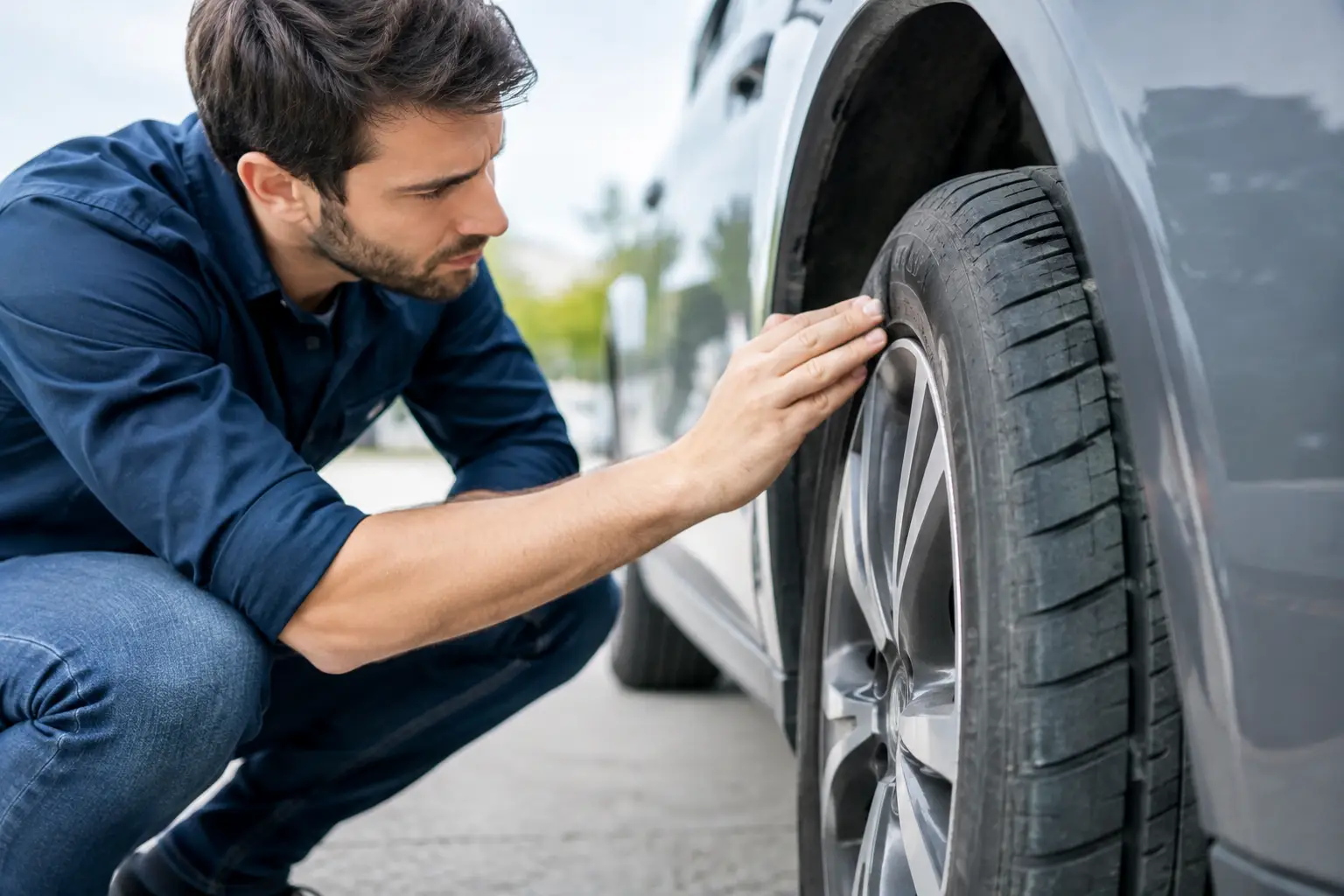
A tyre can look fine from the driveway while hiding a problem that becomes obvious only at speed, in heavy rain or during an emergency stop. A quick inspection takes only a few minutes and can save you from a roadside breakdown, uneven tyre wear or a dangerous loss of grip.
Knowing how to check tyre damage is useful for every driver, whether you commute through Melbourne’s northern suburbs, run the kids to school or use your ute for work. You do not need to be a tyre expert to notice the warning signs. You just need to know what is normal, what is not, and when the car should stay parked until it is inspected.
How to check tyre damage safely
Park on level ground, select park or apply the handbrake, and switch the engine off. If you have just driven, give the tyres a few minutes to cool before inspecting them. Turn the steering wheel fully to one side so you can see more of the front tyre sidewalls, then repeat on the other side.
Use your mobile torch if the light is poor. Walk around the vehicle and inspect every tyre, including the spare if it is accessible. Do not put your hands near moving parts or crawl underneath a vehicle supported only by a jack.
Start by looking for the obvious signs: a tyre that sits lower than the others, a screw or nail in the tread, a bulge in the sidewall, or damage from a kerb strike. These are the issues that deserve attention before your next trip, not after it.
Check tyre pressure first
A tyre that is visibly low may have a slow puncture, a leaking valve, wheel damage or a problem with the tyre bead where it seals against the rim. Check pressures with a reliable gauge when the tyres are cold, using the pressure shown on the vehicle placard. This is usually inside the driver’s door opening, behind the fuel flap or in the owner’s manual.
Do not rely on the number printed on the tyre sidewall. That is the tyre’s maximum pressure, not necessarily the correct operating pressure for your vehicle.
If one tyre repeatedly loses pressure while the others remain steady, it needs to be checked. Topping it up every few days may get you through a short-term situation, but it does not fix the cause. A slow leak can quickly become a flat tyre after a pothole hit or on a hot day.
Look closely across the tread
Tread is what channels water away and helps the tyre grip the road. Look across the full width of each tyre, not just the outer edge you can see while standing beside the car. Turn the front wheels and use a torch to inspect the inside shoulder where possible.
Check for these signs of damage or wear:
- Nails, screws, glass or other objects lodged in the tread
- Cuts, splits, cracking or chunks missing from the rubber
- Tread worn smooth in patches or down to the built-in wear indicators
- Uneven wear on the inner edge, outer edge or centre of the tyre
- A raised section, dip or wavy pattern around the tyre
If you find a nail or screw, avoid pulling it out. It may be partly sealing the puncture, and removing it can cause the tyre to deflate rapidly. Arrange an inspection instead.
Australian tyres must have at least 1.5 mm of tread depth across the required tread area, but waiting until the legal minimum is rarely a good plan. Worn tyres lose wet-weather performance well before they are completely bald. If the wear indicators are level with the tread, it is time to organise replacement.
Check the sidewalls for cuts and bulges
Sidewall damage is one of the most serious things to find during a tyre inspection. Unlike the tread area, the sidewall flexes constantly while you drive. A deep cut, blister or bulge can mean the tyre’s internal cords have been damaged.
Run your eyes around both sidewalls and look for cracking, scuffing, gouges and swelling. Light surface scuffing from brushing a kerb may be cosmetic, but a deep cut that exposes fabric or cords is not safe to drive on. Nor is a bulge, even if the tyre is still holding air. A bulge often follows a hard hit on a pothole, kerb or rough road edge and can lead to sudden tyre failure.
If you see exposed cords, a bubble, a deep sidewall cut or a split, do not drive the vehicle. Fit a safe spare if you have one and know how to do so, or call for roadside assistance.
Pay attention after a kerb or pothole impact
Not every pothole strike causes visible tyre damage straight away. The impact may damage the tyre, bend a wheel, knock out wheel alignment or affect suspension components. Over the next few drives, watch for vibration through the steering wheel, a new pulling sensation, a thumping noise or pressure loss.
Inspect the wheel rim as well. A cracked, bent or badly gouged rim can allow air to escape and may prevent the tyre from sealing correctly. Alloy wheels can crack after a severe impact, sometimes on the inside edge where it is harder to see.
If the steering wheel is no longer straight when driving on a level road, or the vehicle pulls to one side, book an inspection. Continuing to drive with incorrect alignment can wear out a good tyre surprisingly quickly.
Understand what uneven tyre wear is telling you
Tyres do not wear evenly by accident. The wear pattern often points to an issue that needs attention elsewhere on the vehicle.
Wear concentrated in the centre of the tread can indicate over-inflation. Wear on both outer shoulders commonly suggests under-inflation. One worn inner or outer edge may be linked to wheel alignment, while cupping or scalloped dips can be caused by worn suspension parts, wheel balance issues or tyre problems.
These patterns are clues rather than a final diagnosis. Tyres can also wear unevenly because they have not been rotated at appropriate intervals, the vehicle is regularly heavily loaded, or a driver frequently travels over rough roads. A mechanic can inspect the tyres alongside the steering, suspension and wheel alignment to find the actual cause before new tyres are fitted.
Know when a tyre can and cannot be repaired
Some punctures in the central tread area can be repaired safely by a qualified tyre professional, depending on their size, position and the condition of the tyre. A small puncture is not automatically a reason to replace a tyre.
However, a puncture in or close to the sidewall is generally not repairable. Neither is a tyre that has been driven flat for any meaningful distance, as the internal structure may be damaged even if the outside looks acceptable. Large cuts, exposed cords, bulges and severe cracking call for replacement.
Be cautious with tyre repair aerosol or sealant. It can be useful in a genuine emergency if your vehicle instructions allow it, but it is not a permanent repair and can make a later repair more difficult. Drive only as far as necessary and have the tyre assessed as soon as possible.
Do not forget the spare tyre
A spare tyre is easy to overlook until the day you need it. Check that it is present, properly inflated and free from visible cracking or damage. If your vehicle has a space-saver spare, read its speed and distance restrictions before using it. It is designed to get you to a repairer, not to replace a full-size tyre for everyday driving.
Also make sure the jack, wheel brace and locking wheel nut adaptor are in the vehicle. Finding out that a locking wheel nut key is missing on the side of the road is an avoidable frustration.
When to stop driving and call for help
It is safer to stop and arrange assistance if you have a flat tyre, a sidewall bulge, exposed cords, a deep cut, severe vibration, or a tyre that is losing pressure quickly. Reduce speed gradually, avoid sudden steering inputs and pull over in a safe place away from traffic where possible.
For less urgent concerns, such as uneven wear, recurring low pressure or a suspected wheel alignment issue, arrange an inspection before the problem becomes more expensive. Hazara Mobile Mechanic can inspect tyre-related concerns at your home or workplace in Wallan and Melbourne’s northern suburbs, saving you the extra trip to a workshop.
Your tyres are the only part of the vehicle that touch the road. A short check before a long drive, after a pothole impact or whenever the handling feels different is a simple habit that keeps small problems from turning into an unsafe journey.
Need a mobile mechanic?
Hazara Mobile Mechanic comes to you across Wallan and up to 70 km around. Open 7 days, 7am to 10pm, with emergency service 24/7. Call or text 0466 666 945, message us on WhatsApp or book online. See our services and the areas we cover.
